Chapter 10: Adding a brake controller and all required wiring to your non-tow package equipped Gen 2 V6 Tacoma.
As allways, if you are un-sure or un-comfortable with your wiring abilities please do not attempt this and take your truck to your local RV dealer and they will be happy to install a brake controller and associated wiring for you. I accept no responsibility for damage to your truck if you choose to attempt this install yourself.
OK, first off I owe a big thank you to
boser65 who asked me about this and then proceded to help me with photos and voltage measurements from his truck so that I could figure out exactly where to splice and route the wiring to. So any of you who this benefits, should definately sent him a thank you and some positive rep for putting up with my questions and being the test subject for this.
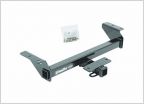
Ok, This is going to assume that you have already added the receiver of your choosing, the Hoppy 43355 4-flat wiring harness, and the 4-flat to 7-round adapter and mounting bracket that I covered in chapter nine. This also assumes that you have already also purchased and selected the mounting location for the brake controller of your choice.
Ok, here we go...
Needed materials:
-30 Amp auto reset circuit breaker
Something like this
-10 feet of 10 Gauge wire (RED)
-10 feet of 10 Gauge wire (WHITE)
-30 feet of 10 Gauge wire (BLUE) (more for double cab long bed)
-5 feet of 16 Gauge wire (BLUE)
-Electrical tape
-Heat shrink tubing of appropriate sizes
-Lighter
-Wire strippers/crimpers
-2 10 Gauge round or forked terminals
-10 Gauge solderless quick connect
-One quick splice for 16-22 Gauge wire
-Assorted zip ties for tidying up the wiring harness when you are done.
I am going to base this on using an Activator III mounted under the driver's seat as I have done, if you opt for a different brake controller or location you will have to vary your cable routing.
Step 1. Disconnect the negative battery terminal.
Step 2. Remove the driver's side sill plate, dead pedal and kick pannel
Covered here starting at step 13.
Step 3. Find the truck's main wiring harness running through the firewall and under the dash and unwrap the electrical tape that secures the harness to the grommit.
Step 4. Feed one end of all your 10 Gauge wire from the engine bay into the truck. Pull enough wiring to reach your desired location, in our case carefully down through the rats nest of cables behind the kick pannel, under the door sill, and then along the exhisting harness under the driver's seat.
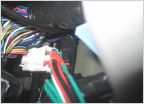
Step 5. Locate the factory brake controller harness, it's up there just above the kick pannel and it looks like this.
We are looking for the solid blue wire.
Step 6. Use your 16 Gauge blue wire and quick splice, and connect them with the solid blue wire above. Tape up your connection and then routhe the other end of your 16 Gauge wire to the under the seat location with the rest of your wires.
Step 7. Secure all the wires you just ran so that they are not obstructing any moving parts such as clutch linkage or the like, and prepare to go under the truck.
Step 8. Route the 10 Gauge Blue wire down to the fuel lines, and along the fuel lines. Securing it with zip ties as you go.
Continue along the fuel line untill you are roughly under the driver's door where you will see the wire loam for the harness that runs to the rear of the truck. Switch to running your new wire along this wire loam, or if you are really resourcefull you could route it into the wire loam, securing it with zip ties as you go.
Step 9. Once you reach the back of the truck you'll be looking at your 4-flat to 7-round adapter. You'll have the 4-flat connectors plugged into one another and secured already, and you'll be looking at a few bare wires. Trailer wiring colors are
supposed to be universal. That should mean that the blue wire on your 7 round adapter is at pin two. (bottom right, the 5 O'clock position as you are behind the truck looking at the plug) Regardless of color, (hopefully it is blue) that is the point where you are going to join the wire you just ran to the 7-pin connector. Make sure to slip the heat shring tubing over the wire before you join them, strip some insullation, use a solderless connector, and crimp the hell out of it. Slide the heat shrink tubing over the connection and shrink it up, then electrical tape it up just to make sure it stays dry. Finish securing the wiring and get ready to move back into the engine bay.
Step 10. Clip the RED 10 Gauge wire so that it is a little longer than it needs to be to reach the mounting location of your choice for the circuit breaker. Connect the end of that wire to one post of the circuit breaker. Connect the remnants of the RED 10 gauge wire between the other post of the circuit breaker and the positive battery terminal.
Step 11. Route the WHITE 10 Gauge wire to the negative battery terminal, and adjust the length of the wire as needed.
DO NOT CONNECT TO THE NEGATIVE BATTERY TERMINAL AT THIS POINT
Step 12. Return to the interior of your truck. Look at your brake controller, and you'll see that there are 4 screws on the back side of it. One marked
Stoplight, One marked
Ground, One marked
Battery, and One marked
Trailer Brakes.
Strip a quarter of an inch of insullation from each of the 4 wires that you previously ran to this location and insert them and tighten each screw down as follows:
RED 10 Gauge wire goes to Battery (+)
WHITE 10 Gauge wire goes to Ground (-)
BLUE 10 Gauge wire goes to Trailer Brakes
BLUE 16 gauge wire goes to Stoplight
Step 13. Re-tape up the grommit and the main harness with your additional wires under the dash to prevent water from entering the cab. Finish securing any wiring as well as the brake controller inside the truck, and put the interior trim pieces back together.
Step 14. Finish connecting the white wire to the negative battery clamp and re-connect the negative battery terminal.
Step 15. Start the truck and step on the brakes. A small dot on the brake controller display will indicate that it is receiving a signal. It will not display a brake power read-out unless it is connected to a trailer with brakes. Back up to your trailer, and ensure that you get a full numerical read-out.
Step 16. Adjust the output and gain as described in the trailer brakes chapter of the towing bible.
Any questions, or if there is anything I can clarify please let me know.